

Have you ever wondered how financially successful people measure their financial status? Well, you might have heard about the term “Net Worth.”
Net worth is an essential aspect of financial health that provides a clear and concise snapshot of your current financial standing.
By having a clear understanding of your net worth and cash flow, you can have a better handle on your finances and plan your financial goals.
So here are the financial apps I’ve used with a net worth tracker.
Stop Wasting Money on Subscriptions You Forgot About!
Rocket Money makes it ridiculously easy to track your spending, cancel unwanted subscriptions, and even lower your monthly bills—all in one place.
Key Takeaways
- Understanding your net worth is key to financial health.
- I compared 11 of the best net worth tracking apps, with Rocket Money coming out on top.
- Track your net worth to monitor your financial well-being and make smart decisions about budgeting, saving & investing for a better future.
- You can determine your net worth by hand, but the best budgeting apps make it all instantaneously by linking with your accounts.
Understanding Net Worth: The Key to Financial Health

Your net worth is the difference between your total assets and your total liabilities (AKA Net worth = Assets – Liabilities).
It’s a snapshot of your financial health at a given moment and can help you identify areas of your life that need improvement.
To calculate your net worth by hand:
- List all your assets, such as money, investments, real estate, and other valuable possessions.
- Compile a list of your debt and liabilities, including credit card debt, car loans, medical bills, and mortgages.
- Subtract your total liabilities from your total assets to calculate net worth.
12 Best Apps For A Net Worth Tracker
How I Picked the Best Net Worth Tracker Apps
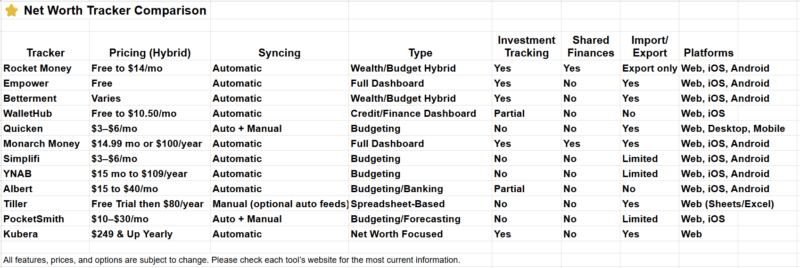
I know how important it is to find a net worth tracker that actually works for your lifestyle and financial goals.
So I spent time digging into what really matters. Instead of just listing popular apps, I reviewed each option using a consistent set of criteria to make sure the recommendations are actually useful.
Here’s what I looked at:
- Core features:
Does the tool track assets, liabilities, net worth, and basic budgeting?
This was the most important factor in our scoring. - Account syncing + ease of setup:
I gave extra weight to tools that offer smooth automatic syncing, since this makes tracking way easier for most users. - Investment and asset tracking:
Apps that handle retirement accounts, brokerage accounts, real estate, and other assets scored higher because they give a more complete financial picture. - Pricing & value:
I compared free plans, paid upgrades, and overall value for the cost. Tools with strong free features or fair pricing ranked better. - Security and data privacy:
Every app had to meet baseline security expectations (encryption, read-only bank connections). Tools with more transparent privacy practices were rated higher. - Ease of use + mobile experience:
Since most people check their finances on the go, I looked closely at mobile dashboards, navigation, and overall user experience. - Who it’s best for:
I considered how well each app serves different types of users — beginners, investors, couples, spreadsheet lovers, etc.
I only included tools that met our minimum standards in all categories and stood out in at least one area (like ease of use, investment tracking, or customization).
These aren’t random picks — they’re the apps I’d feel comfortable using to track our money.
Quick Comparison of the First Five Net Worth Trackers We Like
| App | Automatic Linking | Price | Best For |
|---|---|---|---|
| Rocket Money | Yes | Free to $14/mo | Simple net worth tracking + easy budgeting |
| Empower | Yes | Free | Automated net worth + investment overview |
| Betterment | Yes | Management fee on investment accounts | Hands-off investors using a robo-advisor |
| WalletHub | Yes | Free to $10.50/mo | People who want an all-in-one money dashboard |
| Quicken | Yes | From $2.50/mo | Traditional budgeting + full financial snapshot |
1. Rocket Money
| What We Like | What to Watch Out For |
|---|---|
| • Easy net worth + budget dashboard • Real-time syncing • Subscription tracker |
• Premium required for some features • Limited advanced investing tools • Occasional syncing delays |
Rocket Money gives you a complete view of your finances without juggling multiple tools.
You can connect your accounts for an instant, real-time snapshot of your net worth, including banks, credit cards, loans, and investments.
What we really like is how Rocket Money tracks your net worth over time, so you can actually see your progress month after month. You can also add custom assets like your home or car to get a more complete picture.
Updates are automatic, so you’re never stuck entering figures by hand. It also includes built-in budgeting tools, making it easy to connect your spending habits to your overall financial growth.
Another feature we love is the subscription tracker. It finds recurring charges you may have forgotten about and puts them all in one place.
You can even cancel unwanted subscriptions right inside Rocket Money without having to reach out to the company you signed up with, which can save you money fast without all the hassle.
There’s a free version to get started, with a premium option if you want more features.
If you’re looking for a hands-off way to track your net worth and budget in one place, Rocket Money is a great place to start.
Check out my full Rocket Money review to see how it works and if it’s the right fit for your finances.
Stop Wasting Money on Subscriptions You Forgot About!
Rocket Money makes it ridiculously easy to track your spending, cancel unwanted subscriptions, and even lower your monthly bills—all in one place.
2. Empower
| What We Like | What to Watch Out For |
|---|---|
| • Free net worth + investment tracking • Great retirement tools • Clean dashboard |
• Budgeting is limited • Occasional sync issues • Advisory upsells |
Empower (previously called Personal Capital) is your all-in-one solution for getting a crystal-clear picture of your finances with the best net worth tracker!
This free tool brings all your accounts under one roof, giving you a bird’s-eye view of your financial landscape to track your net worth.
Whether it’s your credit cards, mortgage, loans, investment accounts, bank, or retirement accounts, Empower’s got you covered.
The tools can uncover hidden fees with the fee analyzer, help you budget your funds, and make suggestions for saving more money.
Just link financial accounts and let Empower’s net worth tracker and other features work magic.
You can track your progress over time. This means you can fine-tune your budget and retirement planner to focus on your goals and boost your net worth.
Read more about why Empower is my #1 pick for budgeting and finances with my in-depth Empower Review.

Get clarity on your money, with tech you can trust. See all your accounts in one place, including your investments. And go deeper with our planning and analytics tools.
3. Betterment

| What We Like | What to Watch Out For |
|---|---|
| • Easy automated investing • Net worth syncing available • Great goal-based tools |
• Not a full budgeting app • Advisor access costs extra • More investing-focused than tracking-focused |
Looking for a user-friendly investment platform? Betterment might be just what you need. It’s available as a smartphone app or on your desktop, making it super convenient.
Betterment is like having your own personal financial advisor, but it’s automated! It works its magic based on your personal finance goals.
First, it identifies how much risk you’re comfortable with through easy questions. Then, it suggests a portfolio of exchange-traded funds (ETFs) tailored to you.
Now, here’s the cool part of tracking your net worth.
Betterment allows you to link your bank accounts to its platform. That means you can monitor your assets and debts from one central dashboard.
Plus, it gives you a risk score for your retirement accounts and can uncover sneaky fees that might be eating into your earnings.
And if you like setting goals, Betterment’s got your back. It helps you track your net worth as you work towards those milestones.
Betterment charges a management fee for your investment accounts, but there’s no fee for your checking and cash reserve accounts.
To read more about this helpful Robo-advisor, read my honest Betterment Review.

Investing made better! Meet the app that gives you the tools, inspiration, and support you need to become a better investor.
4. WalletHub
| What We Like | What to Watch Out For |
|---|---|
| • All-in-one dashboard • Daily credit updates • Strong free version |
• Not investment-focused • Busy interface • Best features behind paywall |
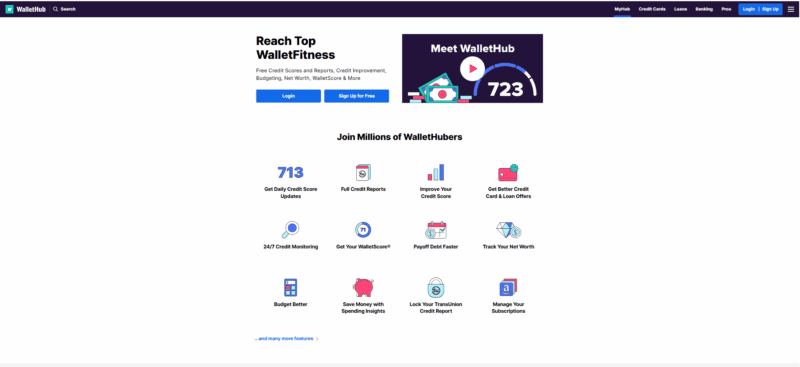
WalletHub is a solid option if you want one place to keep your money life organized. Instead of bouncing between apps, you can check your credit score, your spending, your bills, your subscriptions, and your net worth tracker all on the same dashboard.
It’s basically the “everything in one spot” approach, which honestly just makes life easier.
What I love about WalletHub is the focus with WalletHub is more on everyday money habits than deep investing.
You get daily credit score updates, alerts when something changes on your report, and a clear look at where your money is going each month which helps you stay aware of your financial situation.
If you decide to upgrade, WalletHub adds helpful tools like the Credit Builder, credit lock, and dark web monitoring, which give you a little more protection and support while you’re working on your finances.
For the net worth tracker, WalletHub keeps things simple. It syncs your accounts, updates automatically, and shows your overall trend.
Premium users also get more detailed tracking, including investment and subscription monitoring, which can make it easier to see the full picture.
One thing I appreciate is that you can start with the free version – not a trial version. If you want more detailed monitoring and insights, the paid plans — $7.99/month and $10.50/month billed annually — unlock those extras.
That’s where the upgraded features come in, like identity protection tools and more advanced reports that help you keep an eye on things.
The downside is that WalletHub packs a lot into the interface. Some people will love having everything right there, and others might feel like it’s a little busy.
If you’re someone who likes seeing the big picture — credit, spending, bills, everything — it’s a really helpful tool to use to help you gain financial freedom.

WalletHub helps you make the most of your money. Strengthen your credit, budget better, track all your accounts, grow your investments, and safeguard your identity — all in one app.
5. Quicken

| What We Like | What to Watch Out For |
|---|---|
| • Deep, detailed financial reports • Strong manual + automatic net worth tools • Long-established software |
• Interface feels dated • More complex than most users need • Desktop-heavy experience |
Quicken is one of the best budgeting tools that simplifies figuring out your net worth easily. And it’s affordable, with plans starting at $2.50 a month for all their money management tools.
Picture it as your financial advisor dashboard for your monthly budgets, displaying your bank balance, credit card debt, and more—a quick and convenient financial snapshot.
The impressive aspect of Quicken lies in its ability to keep you informed about your assets and liabilities in real-time, providing a comprehensive overview of your financial landscape.
For example, if your home’s value increases or your car loan decreases, Quicken automatically updates these changes, giving you instant changes on your money.
What sets Quicken apart is its knack for eliminating guesswork from money management.
Whether you’re saving for a dream vacation or striving to gain control over your spending, Quicken effortlessly paints the full picture of your finances.
To learn, check out my full Quicken Review.

Take complete control of your finances with Quicken! Plan for today and tomorrow with their award-winning software and apps.
6. Monarch Money

| What We Like | What to Watch Out For |
|---|---|
| • Beautiful, modern design • Strong for couples • Excellent budgeting + net worth tools |
• Paid subscription only • Some re-auth/syncing required • More setup time than simple apps |
Monarch Money is your ultimate financial tracking tool. Imagine this: all your financial accounts are neatly organized in a single, user-friendly dashboard.
We’re talking bank accounts, loans, credit cards, real estate, investments, and more.
But here’s the kicker – Monarch Money also lets you manually add and track unique assets, like that precious artwork or other valuable collectibles you own.
But that’s not all! Monarch’s dashboards are fully customizable. You can tailor them to focus on how much you spend or the net worth aspects that matter most to you.
Price-wise, Monarch Money offers 7 days free to try out Monarch Money. After the free trial, you can pay $14.99 monthly or $99.99 annually.
Read more about managing your money with my Monarch Money Review.

The modern way to manage your money!
Track all of your accounts in one place, collaborate with your partner, and create a long term plan to achieve your goals. Get personalized advice along the way.
7. Simplifi

| What We Like | What to Watch Out For |
|---|---|
| • Great for everyday budgeting • Clean mobile app • Solid spending insights |
• Subscription required • Fewer long-term wealth tools • Not as strong for complex investments |
Simplifi by Quicken streamlines net worth tracking in a financial command center, seamlessly linking with a vast network of financial institutions.
Simplifi by Quicken is a wizard at suggesting budgets based on your spending history, but the best part is you can tweak it to match your unique preferences.
Simplifi doesn’t stop at bank accounts; it can also link up with your loans, savings, and investment accounts. This means you get a full view of your financial landscape at a glance.
But wait, there’s more! You can set financial goals and track your progress as you work towards them.
Plus, it offers the handy feature of generating reports, giving you a detailed breakdown of your spending – talk about an eye-opener!
Check out my Simplifi Review for more info.

Best Budgeting Apps & Tools. The easiest, most comprehensive way to both see where your money is going and plan for future expenses.
8. YNAB (You Need A Budget)

YNAB, short for You Need A Budget, is one of the best budgeting apps that goes beyond budgeting—it excels at net worth tracking, acting as your central financial hub.
With YNAB, you effortlessly monitor all aspects of your net worth: cash on hand, credit cards, bank saving accounts, investments, retirement funds, real estate, vehicles, and more.
What makes YNAB stand out are its four fundamental principles that point you in the right direction:
- Assign every dollar a purpose: YNAB ensures that every dollar you earn is allocated to a specific goal or true expenses, prioritizing saving and conscious buying.
- Embrace your future expenses: YNAB encourages you to plan for occasional expenses (like annual insurance premiums or car repairs) by setting aside funds gradually with a savings planner so you’re ready when these expenses arise.
- Adapt to life’s changes: YNAB acknowledges that life is unpredictable. It teaches you to be flexible with your budget and adjust to unexpected circumstances gracefully.
- Age your money: YNAB guides you in breaking free from living paycheck to paycheck. It helps you use last month’s income to cover this month’s expenses, giving you financial peace of mind.
9. Albert

Albert is your ultimate financial companion, streamlining all your accounts to provide a comprehensive view of your money- your savings, spending, and even cash back earnings, all in one convenient spot.
What makes Albert stand out is its role as a pocket-sized financial advisor. It monitors your spending, tracks expenses, and enhances your saving habits.
Albert truly shines in the net worth arena. Linking your bank, credit cards, and investments offers a complete financial overview.
It has personal net worth tracking that updates in real-time as your finances evolve. This feature not only lets you track your financial growth over time.
It also empowers you to make informed money decisions based on your holistic financial picture.
10. Tiller

Tiller Money is like a super-smart spreadsheet for your finances. It’s not one of your typical budgeting apps; it’s a simple spreadsheet system that works similarly to Microsoft Excel or Google Sheets.
It automatically pulls transactions from all your financial accounts, so you don’t have to manually punch in numbers, making tracking your finances, loans, investment accounting, and bills easier.
Tiller cleverly sorts your connected accounts into assets and liabilities and updates them. Plus, you can create custom rules to categorize your expenses and income differently.
Tiller is just $79 a year but does offer a 30-day free trial.
11. PocketSmith

PocketSmith is an incredibly user-friendly app that’s perfect for keeping a close watch on your finances.
Its standout feature is its seamless bank connections, giving you a unified view of all your financial information in one place.
But it’s not just about tracking your spending; PocketSmith also provides insights into how your current choices might affect your future financial health.
What sets PocketSmith apart is its ability to simplify net worth tracking. It makes monitoring your savings, debts, and investments easy for clearer cash flow forecasting.
PocketSmith has three different plans ranging from $9.99 to $26.99 a month (billed annually). It does offer a free plan, but the features are quite limited.
12. Kubera

Kubera is a modern net worth tracker that helps you keep an eye on your financial world.
With Kubera, you can connect your investments with online brokers, cryptocurrencies, real estate, or vehicles.
It offers a secure platform to track your other assets and safely store important documents. Your financial information is well-protected here.
Kubera offers two plans – The Personal Plan is $150, and the Family Plan is $225.
How to Pick the Right Net Worth Tracker for You
Picking a net worth tracker gets a lot easier when you think about how you manage your money and what features you actually need. Use the quick guide below to figure out which app fits your situation best.
1. Start With Your Goals
Knowing what you actually want to track makes the whole process way easier and helps you skip the apps that don’t fit your needs.
- Budgeting + savings only? → Rocket Money,Simplifi or Quicken
- Investments + long-term wealth picture? → Empower or Monarch Money
- Multiple assets (real estate, crypto, business income)? → Monarch Money or Empower
- Trying to clean up messy finances and start fresh? → Rocket Money, WalletHub, Simplifi or Monarch Money
- Just want something easy to check once a week? → Simplifi
2. Decide How You Want to Sync Your Accounts
Some people like everything to update automatically, and others want to enter things manually. Once you know which camp you’re in, your options get clearer fast.
- Want automatic syncing with the least friction? → Rocket Money, Empower or Monarch Money
- Prefer a faster, simpler setup? → Rocket Money orSimplifi
- Prefer entering things manually? → Quicken or Tiller
- Want to link some accounts but track others manually? → Monarch Money
- Don’t want to sync your bank at all? → Tiller (spreadsheet-only option)
3. Think About How You Manage Money
How you handle your day-to-day finances matters especially if you share money with someone else or keep things separate.
- Sharing finances with a partner? → Rocket Money, Monarch Money
- Managing everything solo? → Empower or Simplifi
- Handling money across multiple accounts? → Rocket Money, Empower or Monarch Money
- Tracking shared bills but keeping some accounts separate? → Rocket Money or Monarch Money
- Like to categorize every little thing? → Tiller or Monarch Money
4. Look at Fees and Features
Every app does something a little different, so match what you’re willing to pay with the features you actually want.
- Want the strongest free option? → Rocket Money, Empower or WalletHub
- Want a modern dashboard + customization? → Rocket Money or Monarch Money
- Want something simple and affordable? → Rocket Money, WalletHub or Simplifi
- Want deep reports and historic data? → Empower or Quicken
- Want spreadsheet-level control? → Tiller
- Want the best mobile experience? → Rocket Money, Simplifi or Monarch Money
5. Match the Tool to Your Style
Everyone tracks money a little differently, so pick the tool that feels the easiest to stick with.
- Big-picture dashboard (net worth + investments)? → Rocket Money, Empower / Monarch Money
- Beginner-friendly and easy to set up? → Rocket Money, WalletHub or Simplifi
- Manual or spreadsheet-first? → Tiller / Quicken
- Joint finances or shared budgets? → Monarch Money
- Want pretty charts and visuals? → Monarch Money or Empower
- Want something “set it and forget it”? → Rocket Money or Empower
FAQs
1. What makes up my net worth?

Your net worth is like a financial scorecard, showing the difference between your assets and liabilities.
Your assets are the things you own — savings, investments, retirement accounts, and the equity in your home. Your liabilities are the things you owe, like credit cards, loans, and your mortgage.
When you put those two sides together, the math is simple: add up your assets, subtract your liabilities, and the number you’re left with is your net worth.
2. What is the average net worth per person today?

The latest Federal Reserve report gives us a pretty clear picture of where Americans stand financially. Looking at the data from 2019 to 2022, the average household net worth climbed to about $1.06 million — but that number is heavily inflated by the ultra-wealthy.
The number that actually matters for most of us is the median net worth, which came in at $192,900, according to recent analysis from NerdWallet.
That’s a much more realistic snapshot of where the typical family sits and a far better benchmark to use when you’re tracking your own net worth.
3. How much should my net worth be by age?

There’s no perfect number you should hit, but looking at the latest NerdWallet data gives us a helpful baseline for what’s “normal” at different ages.
According to their breakdown of Federal Reserve numbers, the median net worth by age looks like this:
- Under 35: about $39,000, with higher-earning households averaging closer to $183,500
- Ages 35–44: around $135,600 median, and roughly $549,600 on the higher end
- Ages 45–54: about $247,200 median, with top households averaging around $975,800
But remember — these are just reference points, not rules. Everyone’s money journey looks different depending on income, debt, career changes, kids, and even where you live.
4. Does net worth actually matter?

It really does — especially when you’re using a net worth tracker to see the big picture. Net worth isn’t about comparing yourself to anyone else; it’s about knowing whether you’re actually moving forward.
You can make great money and still feel broke if your debts keep growing. A net worth tracker helps you see the truth in black and white.
What matters most is the direction it’s heading. When you consistently pay down debt and invest, your net worth climbs, and your net worth tracker makes that progress feel real and motivating.
The goal isn’t a specific number — it’s steady growth toward financial freedom.
5. How often should I update my net worth?
A good rule of thumb is to update your net worth once a month. That’s the sweet spot where you stay aware of what’s going on without getting sucked into day-to-day market noise.
Even companies like Vanguard note that investors make better long-term decisions when they zoom out instead of checking numbers constantly.
Fidelity says something similar — monitoring your progress on a set schedule (like monthly or quarterly) helps you stay focused and avoid emotional decisions.
If you’re using a net worth tracker like Rocket Money, Empower, Monarch Money, or Simplifi, your accounts are updating in the background anyway.
Final Thoughts

Knowing your net worth is one of the easiest ways to stay on top of your financial health and see whether you’re actually moving toward your goals.
And with so many net worth tracker apps out there, it really comes down to finding the one that fits how you like to manage your money.
Whether you want an all-in-one platform like Rocket Money or prefer to track things yourself, you have everything you need to stay organized and make better decisions with your money.
Start tracking your net worth now with Rocket Money, and you’ll be amazed at how much clarity and confidence it brings to your financial future.
Stop Wasting Money on Subscriptions You Forgot About!
Rocket Money makes it ridiculously easy to track your spending, cancel unwanted subscriptions, and even lower your monthly bills—all in one place.


